
Electric Vehicle Transformation in Corporate Fleets

Corporate fleet management has become central to companies' ESG strategies. As converting fleets to electric vehicles becomes a strong strategic agenda for many sectors, we explore how you can manage this process efficiently using capital.

In the modern business world, traditional internal combustion engine (ICE) vehicle fleets are facing serious transformation pressure due to the European Union's "Fit for 55" regulations and carbon-neutral targets embedded in supply chains. According to European Automobile Manufacturers Association (ACEA) data and sector reports, corporate companies are showing a clearly rising preference for EVs in new vehicle procurement.
According to international energy agency data, the battery pack of a next-generation EV constitutes a significant share of total production cost. This causes electric vehicles to typically be launched at higher list prices than their petrol/diesel counterparts. Adding an eco-friendly asset to the company balance sheet is a visionary step; however, high initial investment costs can create serious pressure on the company's cash flow when the wrong financing model is chosen.

1. Equity Protection and Credit Capacity
Corporate expenditures are fundamentally divided into Capital Expenditures (CAPEX) and Operating Expenditures (OPEX). Purchasing an EV fleet consisting of many vehicles generates a high-volume CAPEX on the company balance sheet. In periods of macroeconomic fluctuation, tying company cash reserves to vehicle investments is a financial impact that should be carefully evaluated.
In contrast, the long-term fleet leasing model converts this transformation into an OPEX process. Usage cost, rather than vehicle ownership cost, is reflected in monthly invoices. Thanks to this operational cost structure, company liquidity and financing planning become more predictable. For detailed planning, see our corporate fleet leasing tips article.
💡 Data Analysis: Opportunity Cost MathematicsIn an investment scenario targeting higher returns in the core business area, the budget tied to vehicles may delay significant potential returns the company could achieve in areas such as technology, R&D, or market expansion. This approach allows financial resources to be deployed in the company's core growth areas.
2. Energy Infrastructure: Standardization in Charging
The most critical element ensuring operational continuity in EV transformation is an integrated energy ecosystem that helps reduce range anxiety for field personnel. Working with professional energy management partners makes this complex transition more manageable. Our charging station selection guide provides a comprehensive framework on this topic.
Load Balancing and Central Office Installations
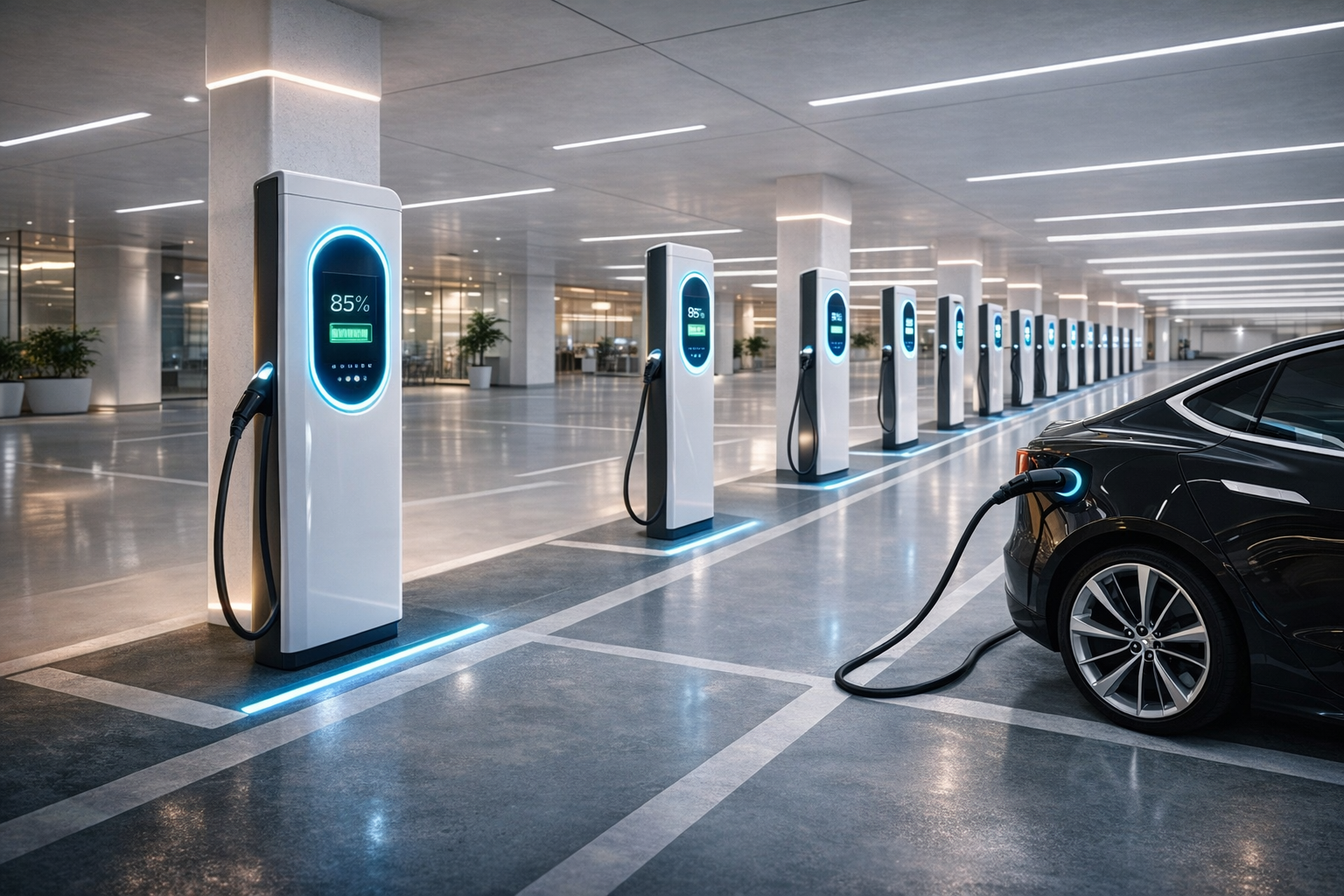
Charging many vehicles at company parking may burden the existing electrical infrastructure. Proper energy infrastructure design optimizes the electricity drawn from the grid between vehicles via "Smart Load Balancing" systems. Consumption data of AC or DC stations installed can be monitored by the fleet manager from a single digital panel.
Home-Type Wallboxes and Cost Management
When company vehicles are taken home by employees, smart Wallbox solutions that can be integrated into residences come into play. The smart meter technology in these systems can separate the employee's personal electricity consumption at home from the energy transferred to the vehicle. Thus, business-related charging is invoiced separately, and no cost confusion arises between the employee and the company.
3. Total Cost of Ownership (TCO) Comparison
In vehicle management, Total Cost of Ownership (TCO) covers not only the purchase price but also insurance, tax, maintenance, energy, residual value loss, and administrative costs. EVs have their own unique cost and service rules for repair and lifecycle. The table below summarizes the responsibility distribution of three different ownership models:
| Cost Item | ICE (Purchase) | EV (Purchase) | EV (Long-Term Leasing) |
|---|---|---|---|
| Upfront Investment (CAPEX) | Company | Company (high) | None |
| Depreciation Management | Company | Company | Leasing firm |
| Comprehensive & Traffic Insurance | Company | Company | Leasing firm |
| Motor Vehicle Tax | Company | Company (discounted) | Leasing firm |
| Periodic Maintenance | Company | Company | Leasing firm |
| Battery Health Risk | None | Company | Leasing firm |
| Replacement Vehicle | Extra cost | Extra cost | Included |
| Second-Hand Sale Risk | Company | Company (high) | None |
| Charging Infrastructure Setup | — | Company | Optional support |
| Accounting Classification | Fixed Asset | Fixed Asset | Expense (OPEX) |

- Tire Wear Processes: Sector analyses show that electric vehicles, which can be heavier than their counterparts due to battery packs, may carry a risk of faster tire wear. On a fleet basis, this means the annual tire replacement budget may be higher than for ICE models.
- Replacement Vehicle and Business Continuity Protection: In the event of a potential breakdown or supply chain disruption, replacement vehicle allocation service helps limit the impact of breakdown-related downtime on operations. In long-term leasing contracts, this service is generally included in the standard package.
4. Authorized Service Network and Spare Parts Access
The high-voltage systems (400V or 800V architecture) of electric vehicles cannot be repaired in traditional vehicle services. The number of brand-certified technicians in Turkey is still limited, which can cause service appointment times to lengthen in some regions. In fleet management, a vehicle waiting 2-3 weeks in service is a direct operational cost item.
In the long-term leasing model, since the leasing firm has pre-negotiated arrangements with the authorized service network, both appointment priority and replacement vehicle allocation are guaranteed by contract. When comparing different brands and models, our 2026 long-range electric vehicles article can serve as a guide.
5. Driver Adaptation and Efficiency Loss
The least discussed dimension of the transition from ICE to EV is driver habits. Accelerator behavior, regenerative braking, one-pedal driving, and charging planning may cause actual range to remain below factory values during the first 3-6 months. In winter, in models without an heat pump, range loss can reach 25-30%.
For fleet managers, this means the monthly charging budget may come out higher than anticipated. Corporate training programs and telemetry-supported driving scoring are effective tools to shorten this transition period. Leasing firms may offer such orientation services within the package.
6. Risk Management: Residual Value and Obsolescence
Rapid progress in technology can make second-hand value estimates difficult for companies purchasing vehicles with equity. As vehicles with newer and more efficient batteries are launched, downward pressure may form on the second-hand value of existing fleet vehicles. For example, a 2026 model electric sedan may experience rapid value loss against solid-state battery models to be released 4 years later.
Long-term operational leasing aims to insulate businesses from technological obsolescence risks. When the contract period ends, the vehicles are returned; the company can update its fleet according to new market conditions without taking on the second-hand sale process. Our Tesla vs BYD comparison provides a current perspective on the general direction of the sector.
Frequently Asked Questions
Is the total cost of EV fleet transition lower than ICE?
In terms of upfront investment, EVs are more costly, but they provide savings in fuel, tax, and maintenance items. Over a 4-year usage horizon, the TCO difference varies by model and km commitment. The main variable affecting the decision is how many km the vehicle travels annually and where charging energy is sourced. A vehicle charged with a home Wallbox remains significantly cheaper operationally than one dependent on public DC fast charging.
Is fleet transition possible without charging infrastructure?
Partially possible but not sustainable. AC/DC points equal to at least 40% of the fleet's vehicle count should be available at the head office or depot. Otherwise, drivers turn to public stations, which increases per-km energy cost by 2-3 times and leads to efficiency loss.
How does the leasing model affect the company balance sheet?
Under IFRS 16 and TFRS 16 frameworks, long-term leasing can be tracked on the balance sheet as a "right-of-use asset" based on contract duration. However, its impact on the cash flow and tax liability side is largely of an OPEX nature. Accountant or financial advisor input is critical for a clear picture specific to your company's situation.
Is gradual transition better than one-off transition?
For most companies, gradual transition is safer. First the executive fleet or a specific region/location is transitioned to EV, and in the first 6-12 months actual range, charging behavior, and cost data are collected. The next slice is planned with the collected data. A one-off transition can cause serious operational disruptions in sites where charging infrastructure is not ready.
Plan Your Corporate Mobility and Energy Needs
To analyze your company's fleet requirements and manage operational risks more controllably, you can explore the models most suitable for you. By evaluating LenaCars' long-term leasing packages and corporate electric-hybrid fleet solutions, you can manage your transformation process with an integrated structure planned from a single point.
Explore Corporate Solutions