
Tesla or BYD? Who Wins the Electric Vehicle Wars?
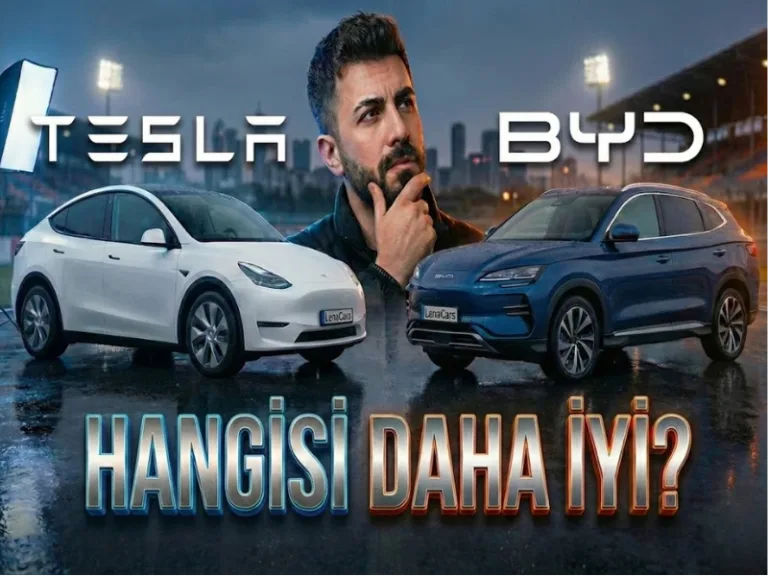
The two giants of the electric car market, Tesla and BYD, face off. A detailed review awaits you, from battery technologies to driving comfort and cost analysis.
The year 2026 is recorded as the biggest transformation year in automotive history. While Tesla tries to maintain its freshness in the market by completely renewing its legendary Model Y series under the code name "Juniper"; BYD is preparing to leverage the "local production" advantage in Turkey with its massive factory investment in Manisa.
On one side is an American dream managing the world's most advanced autonomous driving software and Supercharger network, and on the other is a Chinese dragon producing everything from the chip to the seat, from the battery to the motor within its own structure (Vertical Integration).
Why Should You Lease an Electric Vehicle Before Making This Decision? Tesla and BYD are completely opposite poles in terms of driving character. While Tesla gives you a minimalist, futuristic, and sometimes "harsh" sports car feel; BYD offers a more traditional, premium comfort-focused, and smooth ride. Investing 2-3 million TL in a vehicle you're not sure you'll get used to driving character-wise is a serious financial risk in today's economy.
Additionally, battery technologies in the electric vehicle world are advancing so rapidly that the car you buy today may become "old technology" in 2 years. By leasing from LenaCars' modern Tesla and BYD fleet, you can test both brands in real-life scenarios; in the city, on long roads, and in different weather conditions.
Transfer the risk of technological obsolescence, concerns about second-hand value loss, and maintenance troubles to us; you just discover the two different faces of the future firsthand behind the wheel.
However, the real difference that separates these two giants is hidden in the "chemical war" beneath the chassis, not the body. Is it Tesla's performance monster cells or BYD's blades that guarantee non-flammability? Here are the answers.

🔋 The Invisible War: Battery Chemistry and Cell Architecture
The real difference is made by the massive battery pack hidden under the vehicle's chassis. Both brands follow different chemical paths, offering different promises to their users:
🚀 Tesla (4680 Cell and NCM)Tesla's new generation 4680 cylindrical cells are like a "Sprinter" (Short distance runner). They have very high energy density, are lighter, and offer tremendous power output. These cells are the reason for Tesla's famous acceleration from 0-100. However, NCM (Nickel-Cobalt-Manganese) chemistry is more sensitive to high temperatures and has a slightly more limited charge cycle life compared to LFP cells.
🛡️ BYD (Blade Battery - LFP)BYD's "Blade" battery is like a "Marathoner." It uses Lithium Iron Phosphate (LFP) chemistry. Its biggest feature is that it does not catch fire even in nail penetration tests and has an impressive lifespan of up to 1.2 million kilometers. It is heavier but suitable for daily 100% charging (Tesla recommends 80%). If safety and longevity are your top priorities, BYD is the winner of this war.
Critical Duel: Tesla Model Y Juniper vs. BYD Seal U 📊
These two models, which you will see most often on Turkish roads and are most in demand in our LenaCars fleet, are compared as follows for the year 2026:
| Criteria | Tesla Model Y (Juniper) | BYD Seal U (Face-lift) |
|---|---|---|
| Driving Character | Sporty & Sharp: Steering that gives a go-kart feel, firm suspension. | Comfortable & Isolated: A cotton-like ride, softness that doesn't let you feel the road. |
| Interior Philosophy | Minimalist: A single giant screen, zero physical buttons, simple design. | Premium Traditional: Rotating screen, soft leather, luxury details. |
| Software and Autonomy | Software Giant: Perfect autonomy with FSD v13, instant OTA updates. | Hardware Focused: Android-based system, more limited autonomous capabilities. |
| Charging Infrastructure | Supercharger: An uninterrupted network exclusive to Teslas across Turkey. | General Network: Uses all public stations (ZES, Trugo, etc.). |
Software vs. Manufacturing: Who Wins?
The competition between Tesla and BYD is essentially a "philosophy" difference between Silicon Valley and Shenzhen. Understanding this difference will make it easier for you to decide which vehicle to lease.
Tesla: "A Computer on Wheels with No Margin for Error"
For Tesla, the car is hardware embedded in software. With an update (OTA) that arrives while your vehicle is parked, you may find that your braking distance has shortened or your range has increased by 5% the next morning. The FSD (Full Self-Driving) v13 software, which has become widespread in Turkey by 2026, reads intersections and traffic lights like a human, reducing driving stress to zero.
Driving a Tesla is like using an iPhone; everything is simple, the ecosystem is flawless, but the rules are strict.
BYD: "Every Screw Under One Roof"
BYD's strength comes from "Vertical Integration." While most car brands buy seats from one company, tires from another, and glass from yet another, BYD produces more than 75% of the vehicle in its own factories. This gives them tremendous cost control and a "fast part" advantage. Driving a BYD is like placing the most modern Chinese technology inside a traditional German premium vehicle. It is comfortable, luxurious, and gives you confidence at every stage.
With the Manisa investment, the speed of service and spare parts in Turkey will overturn Tesla's biggest handicap of service waiting times.
Frequently Asked Questions About Tesla and BYD (FAQ) ❓
Does Tesla FSD work at full capacity in Turkey?
As of February 2026, Tesla has made the FSD (Full Self-Driving) system available across Turkey and Europe within certain legal permissions. Vehicles can now change lanes on highways and main arteries, stop and go according to traffic lights, and manage intersections. However, remember that the system is still "supervised" and your hands should remain on the wheel. Additionally, FSD is now offered with a monthly subscription model instead of a lifetime purchase.
Will BYD's Turkey factory (Manisa) reduce leasing prices?
The current situation points the other way. Under a 2024 agreement, BYD was already exempted from Turkey's 40% additional customs duty in exchange for committing to build the Manisa factory — the exemption kicked in when the investment was pledged, not when the factory was completed. As of mid-2026, however, BYD has announced it is suspending the Manisa investment, and no meaningful construction progress has followed. The debate now is not when the factory will deliver a further advantage, but whether the existing exemption will be withdrawn and the taxes BYD has not paid so far reclaimed with late interest. In short, the expectation that "prices will fall further once local production starts" is not realistic at the moment — if anything, the durability of the current advantage is itself in question. We at LenaCars track this closely and base our fleet decisions on verified, up-to-date information rather than announced plans.
Which brand loses less range in winter?
Technically, Tesla's NCM batteries have a slight advantage in cold climates in terms of ion mobility. However, BYD has largely closed the disadvantage of LFP batteries in winter with the "Advanced Heat Pump" it offers as standard in its new generation vehicles. Both vehicles experience a range loss of 15-20% in winter, but Tesla maintains its efficiency slightly better at highway speeds.
Which retains its second-hand value better?
Tesla currently holds a more liquid and valuable position in the second-hand market thanks to its global brand perception and Apple-like loyal audience. However, BYD's investment in Turkey and parts/service assurance will make BYD's second-hand value much more stable in the 2026-2027 range. If you don't want to experience "value loss" stress, you can lease from LenaCars and transfer all these risks to us.
Does having only one screen in Tesla create difficulties in use?
Tesla's "zero button" philosophy requires getting used to it for the first week. Managing everything from the wipers to the mirror from the screen can tire some users. BYD, on the other hand, offers more physical control on the steering wheel in addition to its rotating giant screen and works more harmoniously with your smartphone thanks to Apple CarPlay/Android Auto support (not available in Tesla).
Which has better fast charging (DC) speed?
Tesla Model Y can add 250 km of range in 15 minutes at Supercharger stations with charging speeds up to 250 kW. BYD models generally remain in the 150 kW range, offering a slightly more conservative speed. The reason for this is to maintain battery health (Blade Battery) for many more years. If you're in a time race on long roads, Tesla is ahead; if long-term battery health is your priority, BYD leads.
Decision Table: Which Suits Which User 📊
| Priority | Tesla Model Y | BYD (Atto 3 / Seal / Han) |
|---|---|---|
| Fast-charging speed | Faster, an advantage on long trips | More conservative, prioritises battery health |
| Comfort charging to 100% daily | Limited recommendation (80% advised) | More relaxed, LFP chemistry suits this |
| Software / autonomous driving | More advanced, subscription-based | More basic but adequate |
| Phone integration | No CarPlay/Android Auto | Available |
| Driving character | Sporty, firm | Comfort-focused, smooth |
| Winter range loss | Slightly better (ion mobility) | Largely closed the gap with a heat pump |
There is no clear winner here, and there should not be. The two brands target different user profiles. Someone who drives long distances, wants the latest software and enjoys sporty handling will lean towards Tesla; someone who prioritises daily comfort, phone integration and a more relaxed charging routine will lean towards BYD.
Frequently Asked Questions ❓
Which is safer, Tesla or BYD?
Both meet current safety standards. BYD's Blade Battery is marketed as more resistant to thermal runaway thanks to its LFP chemistry; Tesla stands out for its driver-assistance systems. "Which is safer" has no single answer.
When will BYD's Manisa factory come online?
Uncertain. The investment was pledged in 2024 with production planned for late 2026, but as of mid-2026 BYD announced it was suspending the project. A firm date cannot be given at this stage.
Which holds resale value better?
Tesla has been on sale in Turkey longer, so its resale data is more established. BYD's resale performance has not yet formed a clear pattern, as the brand is still new to the market.
Which brand has a wider service network?
This changes constantly, so we recommend confirming the current dealer and service point count directly with the brand's Turkish distributor before buying.
Does it make sense to rent one first to try it out?
Yes. Before committing to a 2-3 million TL purchase, renting each brand for a few days to test the driving character, charging routine and software experience is the most practical way to avoid post-purchase regret.
Choose Your Side, Drive the Future with LenaCars ⚡
Will you choose Tesla's adrenaline-filled performance or BYD’s unyielding safety and comfort? Minimize your margin of error before deciding. Lease the brand you want from LenaCars' fully maintained, 2026 model electric vehicle fleet; experience the technology firsthand and make your decision. All operational risks are on us, unlimited technology enjoyment is on you.
Explore the Electric Fleet → 📞 Expert Consultant Line