
Electric Vehicle Charging Station Guide: 11kW or 22kW?
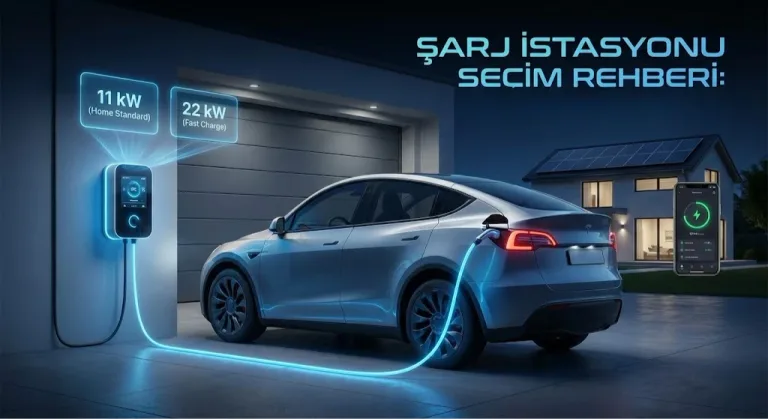
Which is the right charging station for your home? Learn about the differences between 11kW and 22kW, cable types, and safe installation in this guide.
Why Do You Need Your Own Charging Station?
Owning your own charging station (Wallbox) is not just a prestigious "comfort" matter — it's also a serious financial savings strategy. Commercial DC (Direct Current) fast charging stations on highways sell you electricity 3 to 4 times more expensive than your home bill because of high installation and operating costs.
With an AC (Alternating Current) charging station installed at home, you charge your vehicle slowly, healthily, and very cheaply. Especially if you request the "Three-Time Tariff" (Night Tariff: between 22:00 - 06:00) from your electricity distribution company, by charging your vehicle at night you can reduce the fuel cost per kilometer by 80% compared to a gasoline vehicle.

1. The Power Question: 11 kW or 22 kW?
The first thought that comes to everyone's mind when buying a station is "Let me get the most powerful and fastest one". However, in the electric vehicle world, the boss is not the station on the wall, but the Onboard Charger (OBC) inside your car. The station is just a bridge that safely delivers electricity to the vehicle; the real brain that converts electricity from AC to DC and pushes it to the battery is inside the car.
- 11 kW Stations (Gold Standard): Requires three-phase electrical infrastructure. Delivers 11 kW of energy per hour. The onboard AC charging capacity of almost all vehicles on the market — Tesla Model Y, TOGG T10X, Kia EV6, or BMW iX — is 11 kW. So when you plug these vehicles into an 11 kW station, your battery goes from zero to 100% in about 6-8 hours (a full sleep cycle). It's the most ideal, most sensible option for home use that won't strain your home's fuses.
- 22 kW Stations (Speed Beast): Also requires three-phase infrastructure, but it's essential that the cables and your home's main fuse be strong enough to handle this massive load. If you own one of the rare vehicles that supports 22 kW AC charging — Renault Zoe or Porsche Taycan (optional) — you can reduce your charging time to 2.5 - 3 hours.
⚠️ Most Common Mistake: If your vehicle's OBC capacity is at most 11 kW, there is no point installing a more expensive 22 kW station at home. Your vehicle will still charge at maximum 11 kW speed (its own limit). Don't waste your money!
2. Power Options Side by Side
To make your decision easier, let's summarize three different home charging solutions in a single table:
| Criterion | 3.7 kW (Single-Phase) | 11 kW (Three-Phase) | 22 kW (Three-Phase) |
|---|---|---|---|
| Electrical Infrastructure | Standard household socket | 3-phase, reinforced panel | 3-phase, upgraded main fuse |
| 60 kWh Battery Charging Time | 16-18 hours | 6-8 hours | 2.5-3 hours |
| Suitable For | Short-range city EVs, plug-in hybrids | Tesla, TOGG, Kia EV6, BMW iX (most vehicles) | Renault Zoe, Porsche Taycan (optional) |
| Average Device Price | Low | Medium | High |
| Cable Cross-Section (short run) | 3x2.5 mm² | 5x4 mm² | 5x6 mm² or above |
3. Cable and Socket: Fixed or Plug-in?
The universal AC charging standard for electric vehicles in the European Union and Türkiye is the Type 2 socket. So there is no chance that the station you buy won't fit your vehicle (unless it's an old generation car). However, you need to make a critical decision here that will determine usage comfort:
🔌 Tethered (Fixed Cable) Models
The charging cable is directly integrated into the device (usually 5 or 7 meters long). You get out of your car, take the cable from the station and plug it directly into the vehicle. Because there's no hassle of pulling a dirty cable out of the trunk and rolling it up in rainy and cold weather, we 100% recommend this model for individual garage use.
🕳️ Untethered (Socket) Models
The device has only a socket hole on it. You need to take your own Type 2 - Type 2 cable from the trunk of your vehicle and connect one end to the device and the other end to the vehicle. It should only be preferred in cases where the device is in a public parking lot and the cable is at risk of theft/damage.

4. Smart Features: Much More Than Just a Socket
Although there are very cheap "dumb" devices on the market that just deliver electricity (Plug & Charge), for the health of your electrical infrastructure and your comfort, you must definitely choose "Smart" Wallbox models. Here are the vital features to look for in the device:
- 📱 Wi-Fi and Mobile App Support: Allows you to start and stop charging from where you sit, report past kWh consumption, and schedule charging as "start at 22:00 at night".
- 🔒 RFID Card or Password Security: If your station is in the apartment's common enclosed parking lot, it prevents your neighbors from using electricity illegally while you're away. The device is only activated with the card you scan.
- ⚖️ Dynamic Load Balancing: This is the most critical feature for your home! When the car is charging and you turn on the oven, air conditioner, and iron at the same time, your home's main switch may trip. Smart stations with load balancing sensors measure the current electricity consumption of the home and automatically reduce the power going to the car, preventing the fuses from tripping.
- ⚡ Integrated DC Leakage Current Protection (6mA): Catches deadly DC (Direct Current) leaks that can leak from electric vehicles to the grid. If this protection is not inside the station, you will have to install a very expensive "Type B Residual Current Device" externally in the electrical panel.
5. Installation Cost and Conscious Budget Planning
A charging station project doesn't end with the device cost. When determining your total budget, you need to consider three main items: device, cable/panel labor, and infrastructure reinforcement if any. In home 11 kW installations, the main variable is cable distance; if your main panel is 5 meters from the parking area, the cost is low, if it's 25-30 meters away, the job seriously grows.
- Device (Wallbox): Smart 11 kW devices have a wide price range depending on the brand; features like RFID, app, and load balancing carry the device to the mid-segment.
- Cable and panel labor: Varies based on cable distance and panel reinforcement. Correct cable cross-section (5x4 mm² or 5x6 mm² non-flammable halogen-free) is vital.
- Fuse and grounding: A separate fuse line for the electric vehicle, grounding check, and if necessary, DC leakage current relay installation.
- Apartment permits: Site management approval, common area usage decision may be required; the process may extend a few weeks.
For a general view on your public charging habits, see our credit card revolution in charging infrastructure article; for charging speed and battery life interaction, see our heat pump and range article.
Installation and Hardware: Definitely Leave It to the Expert
Installing an electric vehicle charging station is not like installing a washing machine or a lamp at home. Vehicles draw massive power like 11 kW continuously for hours. An incorrectly drawn thin cable, low-quality fuse, or insufficient grounding can lead to cables melting, the device burning, and even fire risk.
You must work with expert institutions with an electrical engineering background and TSE certification, and make sure that the cable cross-section calculation (5x4 mm² or 5x6 mm² non-flammable halogen-free cable according to distance) is done correctly.
💡 Tip: While there are countless brands and models on the market, e-commerce platforms specialized for electric vehicle charging equipment such as Sarjagel.com, which offer technical support and reliable shipping, are lifesavers in choosing the right and safe device.
Frequently Asked Questions
What should I consider for installation in my apartment garage?
A site management board decision and, if necessary, a joint property owners' meeting approval are generally required. Drawing a line not from the common area electricity line but from your own apartment's meter is the cleanest way both legally and in terms of billing. Make sure that fire detection and ventilation systems are not damaged during installation.
Can I install a Wallbox if I'm a tenant?
Since ownership belongs to the landlord, written permission is required; portable mounting types can be preferred so that the device is not considered a permanent fixture. Some contracts may have additional conditions for "intervention in fixed installation"; always get written approval before installation.
Is charging integration possible if I have a solar panel?
Yes. Smart Wallbox models marketed as "solar-aware" can detect solar energy production and adjust the vehicle's charging speed based on the energy produced. In this scenario, on sunny days, it's possible to charge entirely with solar production without touching the grid electricity; however, system installation and integration is expert work.
What can I do instead of a Wallbox as a short-term EV user?
If you're going to use an EV for a few months a year or for trial purposes, the return on investment weakens. With a standard household socket (3.7 kW), you can fill 100-150 km of range from evening to morning; this temporary solution is sufficient for many users. You can also follow the public AC charging points around you from EPDK maps.
Set Up Your Electric Ecosystem with Perfect Harmony ⚡
Don't overshadow the joy of owning an electric vehicle with surprise expenses. While zeroing out battery health, insurance, and depreciation risks by leasing your vehicle long-term from LenaCars, you can reach the most reliable infrastructure by choosing Türkiye's expert e-commerce platform Sarjagel.com's wide product range for your home or workplace charging station equipment.
Explore LenaCars EV Fleet →Corporate EV Fleet Solutions🔌 Sarjagel.com Devices